Is Your Website Ready for the Holiday Rush?
The traffic spikes are predictable. The preparation gap usually isn't.
11.11 just happened. Black Friday is right behind it. Then Christmas, then New Year’s. If your platform survived Singles Day with headroom to spare, you might be tempted to relax. Don’t. Each of these events amplifies the same underlying gaps — and the ones that don’t show up under moderate traffic tend to surface spectacularly under peak load.
The preparation conversation usually focuses on infrastructure scaling: more instances, higher database connection limits, load balancer tuning. That’s necessary but not sufficient. Two factors that consistently determine whether a platform has a good or bad holiday season sit outside the application layer entirely: security posture and edge performance.
The traffic reality
Holiday peaks are not random events — they follow a predictable pattern that starts building in late October and runs through early January.
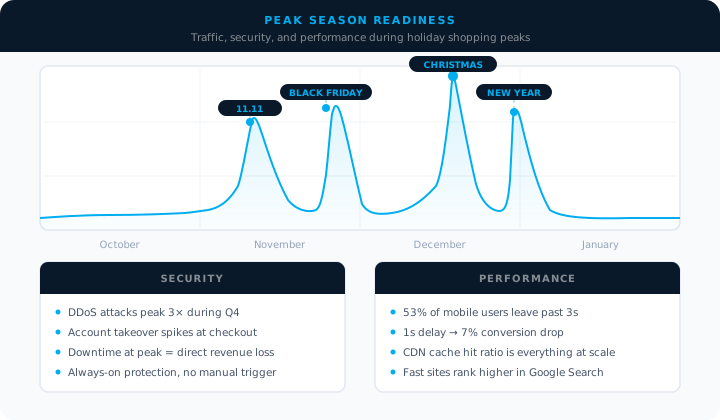
Singles Day (11.11) has become the first major stress test of Q4, particularly for fashion, electronics, and any platform with Asian market exposure. Black Friday has globalised well beyond North America. Christmas peaks earlier than most teams expect — the week before, not the day itself. New Year brings a second wave.
The predictability is actually the frustrating part. These are known dates. There’s no excuse to be caught unprepared — but teams are, year after year, for the same reasons.
Security: attacks follow the money
Attackers understand seasonal patterns as well as your growth team does. Traffic peaks are cover: volumetric attack traffic is harder to distinguish from legitimate surge traffic, and security teams are stretched monitoring a flood of real events. Three patterns repeat every Q4:
Volumetric DDoS at peak windows. The goal isn’t necessarily to take the site down — it’s to degrade performance enough to increase checkout abandonment, or to distract the security team while a more targeted attack runs in parallel. A 4.70s page load drops to 9s under partial DDoS load. That’s the abandonment cliff.
Credential stuffing against saved payment methods. Attackers time campaigns against login flows during peak periods because the volume of legitimate authentication events masks automated traffic patterns. Detection based on request rate thresholds becomes unreliable when everyone is authenticating at once.
Inventory abuse and scalping bots. For limited-inventory products, automated checkout bots deplete stock in seconds. Human customers hit out-of-stock pages. The site stays up but the sale is gone.
Purpose-built protection handles all three without manual intervention: Akamai’s Bot Manager distinguishes real customers from automation using device fingerprinting and behavioural scoring that doesn’t rely on rate thresholds, and DDoS mitigation at the edge absorbs volumetric traffic before it reaches your infrastructure. The key word is always-on — protection that requires a human to activate it during a live incident is protection that activates too late.
Performance: the three-second rule isn’t aspirational
53% of mobile users abandon a site that takes more than three seconds to load. That statistic isn’t new — it’s been true for years — and yet Q4 page load times consistently degrade compared to baseline.
The degradation mechanism is predictable too. Under high concurrency, the components of page load time that look fine at normal traffic levels compound:
- Origin response time increases as database connection pools saturate
- CDN cache miss rate rises for newly created promotional pages and personalised content
- Third-party tag loading (analytics, chat widgets, payment scripts) creates unpredictable jitter
Each of these adds latency. Combined, a platform that delivers 2.8s page loads on a Tuesday in September can land at 5s+ on Black Friday morning — not because anything broke, but because every marginal delay accumulated.
The levers that actually move the needle:
Cache hit ratio on product and category pages. If your CDN is caching 85% of requests, 15% reach origin. At 10× normal traffic, that’s 1.5× normal origin load from cache misses alone. Properly tuned caching headers and cache key configuration push this above 95% — meaning origin sees roughly the same load during peak as baseline.
Edge-side JavaScript and personalisation. Moving lightweight personalisation logic to EdgeWorkers means the CDN can serve customised content from cache rather than punching through to origin for every session. The user gets a personalised experience; origin doesn’t see the request.
Image optimisation and format delivery. WebP with AVIF fallback, sized for the requesting device’s viewport. A hero image that ships 400KB to a 375px mobile screen is a performance tax that runs on every page load. Akamai’s Image & Video Manager handles this at the edge without re-engineering the asset pipeline.
The preparation window is closing
The practical constraint is time: there are only a few weeks between now and Christmas. That’s enough time to audit cache configuration and fix the obvious gaps. It’s enough time to verify that DDoS and bot protection is in always-on mode rather than detection-only. It’s not enough time to rearchitect a slow origin.
Which means prioritisation matters. The highest-leverage work is at the edge — cache tuning, bot protection mode, DDoS posture — because it doesn’t require changes to the application itself. A week of focused edge configuration work before Christmas is more valuable than a month of application-layer optimisation after the peak.